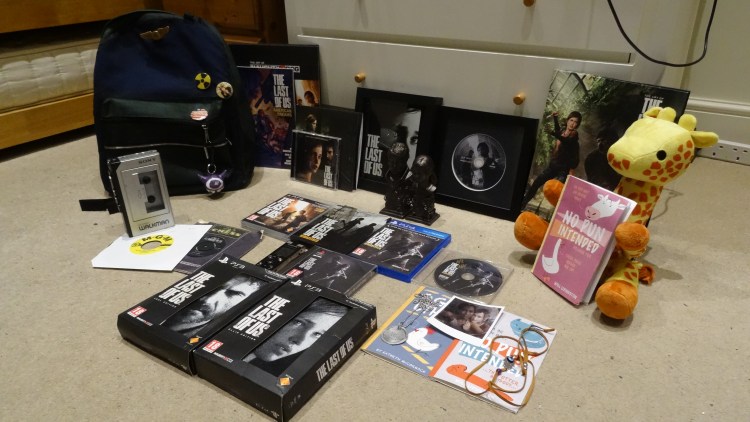
For over 20 years, I was addicted to video games and would play them on a daily basis.
Why though? To escape uncertainty.
The irony is that eventually uncertainty would crash into my world and force me to see the truth.
In 2019 I was sectioned under the mental health act and went to Springfield Hospital.
For the next three years, I struggled to accept the truth that violent video games and gaming in general was a big reason why my mental health deteriorated the way that it did.
I had to let go of gaming altogether… but I refused.
I refused because gaming transported me to worlds where I had purpose like protecting Ellie’s life in The Last of Us and I had a memorabilia and clothing collection of this game.
I was so stubborn in this refusal to the point where I kept insisting to my loved ones that it was ok for me to play ‘The Last of Us: Part II’ a year later in 2020. This was despite the terrifying hallucinations and delusions I had relating to the first game.
I do however, in hindsight, see this game as a blessing in disguise.
The Last of Us: Part II had the most realistic violence in a video game at the time and it shook me to my core.
This shock was the catalyst needed for me to look deep inside myself for the next two years and realise that video games had to leave my life.
I started by playing only non-violent games, then playing for half an hour a day and, eventually, quitting playing games all together in December 2022.
There were two factors that made this vital change possible. Communication and Game Quitters.
When I was at Springfield, a nurse took me around the hospital and cafe and asked me what I was looking forward to after I was discharged.
I told her I wanted to see and be with my family the most. I never mentioned gaming in that conversation.
For the next four years, I have valued communication and honesty about my mental health so much more compared to where I was before I was sectioned.
Talking honestly was the first big step to accept that I needed to let go of old habits to live a life worth living.
Game Quitters came about by simply googling about video game addiction.
What is fantastic about Game Quitters is that it guides you through the step-by-step journey of quitting gaming through lived experience.
I think the fact that helped me let go of gaming the most was that the World Health Organisation classified Gaming Disorder as an addiction in 2020.
With these foundations, I’ve quit gaming and get out of the house more often to meet people and forge strong connections.
While this is a major change, I’ve made further changes that have made my quality of life so much better.
I don’t watch or read BBC News anymore because I find it to be too depressing for my liking and, to me, presents the world as a horrible place with too little light to counterbalance it.
I don’t watch any TV show or movie that has realistic violence. Marvel and Star Wars, to me, feel hopeless to watch. There will never be long lasting peace in either of these fictional worlds and this has made watching them unappealling.
I instead watch non-violent movies on the independent movie streaming service MUBI.
I read non-fiction books as well. It makes me feel calm and relaxed which gaming never provided for me. I get to read stories from people who have similar backgrounds to mine which makes me so happy.
If you feel that you are stuck or focusing on something that’s creating negativity in your life, talk to someone.
My psychosis happened in part because I didn’t talk to anyone about the anger and pain I was feeling towards the world. I stayed silent and payed the price.
I don’t wish mental illness on anyone.
Talk. There is someone who will listen and will help you process and accept what’s happening to you.
Please don’t suffer alone.
 Samuel Mental Health